
matura rozszerzona 2022
Quiz Podsumowanie
0 z 13 pytań ukończono
pytania:
Informacje
Ukończyłe(a)ś już quiz. W związku z tym nie można go ponownie uruchomić.
Quiz is loading…
Musisz się zalogować, aby rozpocząć quiz.
You must first complete the following:
Wyniki
Wyniki
0 z 13 pytań rozwiązane prawidłowo
Twój czas:
Czas się skończył
Uzyskano 0 z 0 punktów, (0)
Earned Point(s): 0 of 0, (0)
0 Essay(s) Pending (Possible Point(s): 0)
Kategorie
- matura 0%
- 1
- 2
- 3
- 4
- 5
- 6
- 7
- 8
- 9
- 10
- 11
- 12
- 13
- Bieżące
- Powtórz
- Poprawnie
- Poprawnie
- Niepoprawnie
-
Pytanie 1 of 13
1. Pytanie
Zadanie 1.1 (0–3)
Przesłuchaj dwukrotnie tekst. Z podanych odpowiedzi wybierz właściwą, zgodną
z treścią nagrania.Tekst 1.1
1.1. The woman recounts her experience in order toPoprawnieNiepoprawnie -
Pytanie 2 of 13
2. Pytanie
Zadanie 1.2 (0–3)
Przesłuchaj dwukrotnie tekst. Z podanych odpowiedzi wybierz właściwą, zgodną
z treścią nagrania.Tekst 2.
1.2. What are the speakers doing?PoprawnieNiepoprawnie -
Pytanie 3 of 13
3. Pytanie
Zadanie 1.3 (0–3)
Wysłuchaj dwukrotnie tekst. Z podanych odpowiedzi wybierz właściwą, zgodną
z treścią nagrania.Tekst 3.
1.3. Which is the best headline for the news item?PoprawnieNiepoprawnie -
Pytanie 4 of 13
4. Pytanie
Zadanie 2. (0–4)
Wysłuchaj dwukrotnie czterech wypowiedzi związanych z kartami płatniczymi. Do każdej wypowiedzi (2.1.–2.4.) dopasuj odpowiadające jej zdanie (A–E). Wpisz rozwiązania obok wypowiedzi.Uwaga: jedno zdanie zostało podane dodatkowo i nie pasuje do żadnej wypowiedzi.
-
This speaker
A. was surprised to receive a refund of the money which had been stolen.
B. publicised some information regarding the theft of money.
C. had to face embarrassing comments on social media.
D. took action despite a positive outcome.
E. felt awkward because of a comment someone made.2.1
2.2
2.3
2.4
PoprawnieNiepoprawnie -
-
Pytanie 5 of 13
5. Pytanie
Zadanie 3. (0–5)
Wysłuchaj dwukrotnie wywiadu na temat kradzieży kaktusów (ang. theft of cacti). Z podanych odpowiedzi wybierz właściwą, zgodną z treścią nagrania. Obok każdego pytania wpisz jedną z liter: A, B, C albo D.-
3.1. According to Ray, the illegal cactus trade has grown recently because
A. the availability of rare species has decreased.
B. demand for cacti has been boosted by fashion trends.
C. there are not enough places selling cacti as souvenirs.
D. the falling price of cacti on the black market attracts more buyers.3.2. When talking about the factors making cactus theft easier, Ray points out that
A. US Fish and Wildlife officers rarely patrol deserts.
B. most cactus thieves manage to avoid getting caught.
C. some aspects of online transactions are not adequately regulated.
D. the number of specialists monitoring online sales has been reduced.3.3. The landscaper who Ray refers to
A. was imprisoned after trying to steal a number of cacti.
B. worked single-handedly when stealing the cacti.
C. was spotted by a ranger driving a pickup truck.
D. managed to get away without a prison sentence.3.4. According to Gene Joseph, cactus theft can be prevented by
A. raising awareness of the harm to nature caused by cactus loss.
B. making people realize how difficult growing cacti is.
C. encouraging people to grow cacti at home.
D. supplying legally grown cacti to the market.3.5. When talking about the use of technology in fighting cactus theft, Ray
A. expresses his concern about the number of microchipped cacti.
B. points to the success of a project aimed at dealing with cactus theft.
C. explains why the adopted method is limited to Saguaro National Park.
D. questions the effectiveness of measures introduced by Saguaro National Park.
PoprawnieNiepoprawnie -
-
Pytanie 6 of 13
6. Pytanie
Zadanie 4. (0–4)
Przeczytaj tekst, który został podzielony na trzy części (A–C), oraz pytania go dotyczące (4.1.–4.4.). Do każdego pytania dopasuj właściwą część tekstu. Wpisz rozwiązania obok pytań.Uwaga: jedna część tekstu pasuje do dwóch pytań.
-
In which paragraph does the author
4.1. link the origin of the dollar sign ($) to a certain geographical landmark?
4.2. point to a non-English origin of the word dollar?
4.3. express regret that the roots of the US dollar sign are difficult to trace?
4.4. compare the value of one currency to another?THE CURIOUS ORIGINS OF THE DOLLAR
A. The dollar has an exciting history. In 1520, the Kingdom of Bohemia began making coins using silver from a mine in Joachimsthal. Logically, the coin was called the Joachimsthaler. Shortened to thaler the name found its way into other languages, for example, daler in Dutch. And, it was the Dutch coin that, thanks to booming international trade, made its way to the Dutch New Netherland Colony. It’s noteworthy that the modern pronunciation of dollar is remarkably close to the 17th-century Dutch pronunciation of daler. Unfortunately, there is no straightforward answer to the question of how the dollar sign originated.
B. One theory is that the dollar sign comes from the Pillars of Hercules, as the Ancient Greeks used to call the two rocks at the entrance to the Straits of Gibraltar. When King Ferdinand II of Aragon claimed the Straits of Gibraltar in 1492, he ordered the production of coins showing the Pillars of Hercules wrapped in a banner. When the Spanish colonized America, the coins travelled with them and so the Pillars of Hercules became a symbol of the New World. In the 18th and 19th centuries they also appeared on the Spanish dollar, known as
the peso. This showed two columns with a ribbon wrapped around them in an S shape. The similarity to the American dollar sign seems obvious.C. Another widely accepted theory also involves the Spanish currency, and it goes like this: in the colonies, trade between Spanish Americans and English Americans was lively, and the Spanish peso was a legal currency in the US until 1857. The word “peso” was often abbreviated to the initial “P” with an “S” beside it. Gradually the “P” merged with the “S”, then the “P” lost its curve, leaving a vertical line in the centre of the “S”. A peso was more or less worth one American dollar. Since both were in circulation simultaneously, the sign
might have been transferred.adapted from www.bbc.com
PoprawnieNiepoprawnie -
-
Pytanie 7 of 13
7. Pytanie
Przeczytaj tekst, z którego usunięto cztery zdania. Wpisz w każdą lukę (5.1.–5.4.) literę, którą oznaczono brakujące zdanie (A–E), tak aby otrzymać spójny i logiczny tekst.
Uwaga: jedno zdanie zostało podane dodatkowo i nie pasuje do żadnej luki.
-
FRUITFUL COMBINATION
The story of banoffee pie, an iconic British dessert with bananas, cream, toffee and a shortcrust pastry base, began in 1968 when a newly-wed couple purchased an old tea room in a 16th-century monastery building in East Sussex. 5.1. After the most urgent tasks had been completed, the owners got down to putting the finishing touches to the interior. They called the place The Hungry Monk, a clear reference to its former residents.
In 1971, Nigel Mackenzie, the owner, decided a new dessert was essential on their menu. At that time Ian Dowding, the head chef, had just returned from America, so he suggested a recipe he had brought back from his trip – Blum’s coffee toffee pie. 5.2. A few experiments with adding apples or oranges proved to be disappointing. But Mackenzie would not give up and he suggested using bananas, which was a stroke of genius. Now it was time to invent the name. Having tested a few ideas, the duo finally opted for banoffee, a combination of words denoting the main ingredients of the dessert – bananas and toffee.
The response from the restaurant’s clients was immediate. Some rang from London before
setting out to check if banoffee was still on the menu. 5.3. But it was not only numerous eateries that took advantage of banoffee’s fame. Supermarkets also sold their own variants, which truly appalled the creators. Meanwhile, the recipe for genuine banoffee appeared in a cookbook, and later the dessert gained its own entry in the Oxford English Dictionary.
Banoffee was a great success and many people thought it must be from America. Therefore, Mackenzie decided to challenge those who were questioning its origin. He offered a 10,000-pound prize to anyone who could prove banoffee was not British. 5.4. It said: The Birthplace of one of the World’s Favourite Puddings. The dessert has indeed won the hearts and stomachs of thousands across the world.adapted from www.independent.co.uk; www.madeupinbritain.uk
A. When no one claimed it, Mackenzie proudly put up a plaque at the restaurant’s entrance.
B. Mackenzie was enthusiastic about the new dish, but both he and his chef felt that they needed to make it distinctly their own.
C. The chef strongly opposed this idea because he disapproved of making changes to the recipes he had come up with.
D. People clearly loved it, so owners of other restaurants throughout the country decided to serve it as well.
E. To convert the property into a restaurant, a number of essential changes had to be made.
PoprawnieNiepoprawnie -
-
Pytanie 8 of 13
8. Pytanie
Zadanie 6. (0–5)
Przeczytaj dwa teksty związane ze słynnymi fotografiami. Z podanych odpowiedziwybierz właściwą, zgodną z treścią tekstu. Wpisz jedną z liter: A, B, C albo D.-
Tekst 1.
MY FIRST ENCOUNTER WITH GORILLAS
I shall never forget the day I met gorillas for the first time. In the middle of an African forest I suddenly heard high-pitched screams in the air. They were followed by a series of sharp pok-pok chest-beats from a great silverback male hidden behind a dense wall of vegetation.
When I actually saw the gorillas, I froze and remained still until the echoes of the screams and chest-beats faded. The group must have been resting and sunbathing. I could distinguish a few black, furry-headed creatures staring back at me. Their bright eyes moved nervously as they attempted to determine if I was a friend or an enemy. The females looked tense. They had moved with their infants to the back of the group, leaving the silverback leader and some younger males in the foreground. Occasionally, the dominant male would rise to chest-beat in an attempt to frighten me away.
I desperately wanted to take a photo of them, so I decided to climb a tree, not one of my better talents. The tree was smooth and slippery and, no matter how hard I tried, I couldn’t get more than a metre above the ground. I was as noisy as a flock of birds in the migration season so the gorillas went back and hid in the thick forest. I was about to give up when Sanwekwe, my African guide, came to my aid by giving me a mighty push upwards. He was shaking with silent laughter while I felt as helpless as a baby taking its first steps. Finally, I pulled myself up onto a branch about six metres above the ground.
By this time I assumed that the noise I had made must have frightened the gorillas onto the next mountain. But to my surprise, the entire group had returned and were watching me like front-row spectators at a circus. All that was needed to make the image complete were a few bags of popcorn and some cotton candy! All the members of the group had revealed themselves because it was obvious to them that the intruder had been distracted by tree-climbing problems, an activity they could understand. I took out my camera, and that’s how probably one of the most publicized pictures of gorillas in the wild was taken. It shows a lineup of sixteen gorillas posing as if for a family photo in a back garden.
6.1. When the author saw the gorillas for the first time,
A. they looked at her anxiously, trying to figure out her intentions.
B. younger males started to make noises in order to scare her.
C. she hid behind a bush to avoid being noticed by them.
D. the females gathered around the dominant male.6.2. The author’s attempt to climb a tree
A. provoked a disapproving comment from her guide.
B. was successful thanks to someone’s assistance.
C. encouraged the gorillas to do the same.
D. made the gorillas come to her rescue.6.3. Which would be the best caption for the photo the author took?
A. GORILLAS WAITING FOR A TREAT
B. GORILLAS CHASING ME UP A TREE
C. GORILLAS FRIGHTENED BY A CAMERA
D. GORILLAS FASCINATED BY MY CLIMBING ATTEMPT
PoprawnieNiepoprawnie -
-
Pytanie 9 of 13
9. Pytanie
Przeczytaj drugi tekst związany ze słynnymi fotografiami. Z podanych odpowiedzi wybierz właściwą, zgodną z treścią tekstu. Wpisz jedną z liter: A, B, C albo D.
-
Tekst 2.
THE MYSTERY OF A FAMOUS KISS SOLVED?
Immediately after President Truman announced Japan’s surrender in World War II,at 7:03 p.m. on August 14, 1945, amid the crowds celebrating victory in Times Square, an American sailor shared a passionate kiss with a nurse who was passing by. Or, at least,that’s how the story went.
In fact, as reported by the New York Times in 2010, Alfred Eisenstaedt’s famous photo “The Kiss” might have been taken hours earlier. Gloria Bullard, who was in Times Square that day, claimed that she had seen the pair who were in the photograph kiss. However, in her eighties, when interviewed by the New York Times, she said that she had returned home on August 14 by dusk. As her house was 40 miles from Times Square, a long train ride away, she can’t have been in New York as late as 7 p.m.
There were also some other doubts as to the circumstances in which the photo was taken. Online comments under the New York Times article pointed to a distinctive shadow that appears on one of the buildings in the photo, cast by another building, now identified as the Astor Hotel. Three academics set out to examine the length and direction of that shadow to determine the time the photo was taken. They found out that the sun must have been “at azimuth 270 degrees and at an altitude of +22.7 degrees” in order to create such a shadow. It could only have achieved that position on the day in question at 5:51 p.m., much earlier than
when the victory was announced.
Although the scientists’ detective work didn’t solve the mystery of the kissing couple’s identity, it helped to eliminate dozens of people who had claimed to have been in the photo. The photographer himself had tried to establish the couple’s identity, and in 1979, he announced that he had found the long-lost nurse. For the next thirty years, Edith Shain was thought to be the woman in the photo. But Eisenstaedt’s attempts to determine the sailor’s identity failed. It was Lawrence Verria and George Galdorisi who provided ultimate proof of
the identity of the couple in their book The Kissing Sailor. They identified the man in the photo as George Mendonsa and excluded Edith Shain as the nurse he kissed. They concluded without any doubt that the woman was Greta Zimmer, a dental assistant from Queens. Why did Edith Shain claim to be the nurse who was kissed? It’s hard to say. The most credible explanation is simply that she wanted her moment in the limelight. Can we be sure that the lastword about the mysterious photo has been said?adapted from www.history.com
6.4. The exact time Eisenstaedt took the photo was established based on
A. an eye-witness account of the event.
B. online comments posted under an article.
C. a scientific analysis of a shadow visible in the photo.
D. research into several articles published in the New York Times.6.5. Which of the following is stated in the text as an opinion, and not a fact?
A. Gloria Bullard can’t have been in Times Square when the victory was announced.
B. The true identity of the couple in the photograph was revealed in a book.
C. Many people claimed to have been the couple that was photographed.
D. Edith Shain pretended to have been the nurse in the photo to draw attention to herself.
PoprawnieNiepoprawnie -
-
Pytanie 10 of 13
10. Pytanie
Zadanie 7. (0–4)
Przeczytaj tekst. Z podanych odpowiedzi wybierz właściwą, tak aby otrzymać logiczny i gramatycznie poprawny tekst. Wpisz jedną z liter: A, B, C albo D.-
ALDWYCH STATION
There are many disused tube stations in London, of which Aldwych Station is the most well-known. It was designed by Leslie Green, a famous English architect.
Before the station opened in 1907, its construction 7.1. two years. From the very beginning the passenger numbers were not very high, yet the station 7.2. importance for a different reason. During the Second World War its platform was used as emergency storage for museum treasures and as an air raid shelter. After the war, the original 7.3. of the station was restored, but low passenger numbers led to its closure in 1994. Now it is a site of historic significance and because of this, the London Transport Museum organizes
sightseeing tours there.
The station plays one more role. It has become a popular filming location. Observant film audiences can recognize the station in productions such as The Patriot Games or Atonement. It is worth mentioning that some of the posters on its platform are not old, but are made 7.4. old for filming purposes.adapted from www.tripsavvy.com
7.1.
A. has been taking
B. had taken
C. was taking
D. was taken
7.2.
A. grew
B. added
C. gained
D. improved
7.3.
A. reason
B. function
C. target
D. meaning
7.4.
A. to look
B. have looked
C. looking
D. to looking
PoprawnieNiepoprawnie -
-
Pytanie 11 of 13
11. Pytanie
Zadanie 8. (0–4)
Przeczytaj tekst. Uzupełnij każdą lukę (8.1.–8.4.) jednym wyrazem, tak aby powstał spójny i logiczny tekst. Wymagana jest pełna poprawność gramatyczna i ortograficzna wpisywanych wyrazów.-
AN UNCONVENTIONAL PAINTER
One day, a boy saw a man climb over the wall of his neighbour’s garden to steal some fruit. He quickly went home and drew a likeness of the thief. The moment his father heard the story and saw the picture, he took it to the authorities. It 8.1. out to be very useful since the thief was soon caught. The boy was Thomas Gainsborough, who grew up to be one of England’s most famous 18th-century painters, known both 8.2. the mastery of his craft and his unconventional methods. He painted in semi-darkness, and sitters for portraits claimed that 8.3. they nor their portraits were visible. When painting a landscape, he did not go outside, but constructed models from cork and coal, sand, moss, and other materials. Yet, 8.4. a result of this unusual practice, Thomas Gainsborough produced some of the most poetic paintings imaginable.
adapted from www.spectator.co.uk
PoprawnieNiepoprawnie -
-
Pytanie 12 of 13
12. Pytanie
Zadanie 9. (0–4)
Uzupełnij zdania 9.1.–9.4., wykorzystując podane w nawiasach wyrazy w odpowiedniej formie. Nie należy zmieniać kolejności podanych wyrazów, trzeba natomiast – jeśli jest to konieczne – dodać inne wyrazy, tak aby otrzymać logiczne i gramatycznie poprawne zdania. Wymagana jest pełna poprawność ortograficzna wpisywanych fragmentów zdań.
Uwaga: w każdą lukę możesz wpisać maksymalnie cztery wyrazy, wliczając w to wyrazy już podane.-
9.1. Unfortunately, the accident prevented (he / complete) the project on time.
9.2. Would you mind (carry / big) parcel of the three? I’ll take the two smaller ones.
9.3. Don’t worry too much (other people / opinion) . They are often formed too hastily.
9.4. People who attended the meeting (be / unable / download) the file yesterday because of the poor Internet connection.
PoprawnieNiepoprawnie -
-
Pytanie 13 of 13
13. Pytanie
Zadanie 10. (0–13)
Wypowiedz się na jeden z poniższych tematów. Wypowiedź powinna zawierać od 200do 250 wyrazów i spełniać wszystkie wymogi typowe dla formy wskazanej w poleceniu.
Określ temat wybrany przez Ciebie, podając jego numer.1. Niektórzy rodzice dają nastolatkom kieszonkowe za wykonywanie obowiązków domowych. Napisz rozprawkę, w której przedstawisz dobre i złe strony takiego rozwiązania.
2. Wiele osób marzy o odbyciu podróży dookoła świata. Napisz artykuł, w którym przedstawisz korzyści wynikające z realizacji takiego marzenia oraz udzielisz rad, jak należy się do takiej podróży przygotować.
Prace oceniane są według poniższej tabeli:
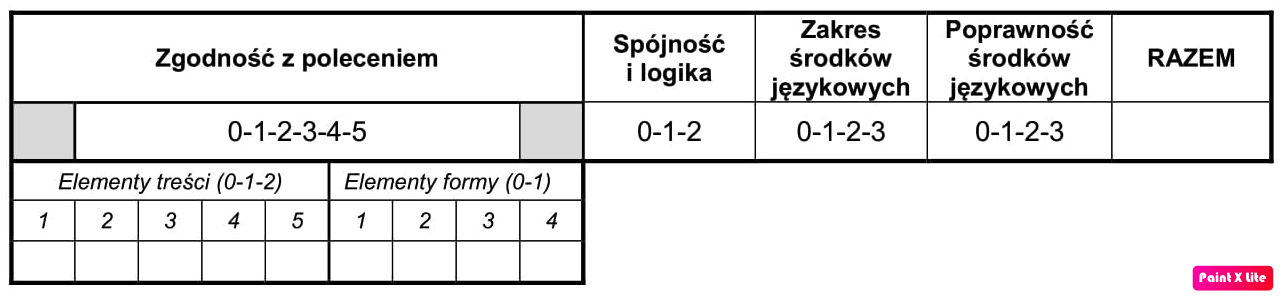 Na początek zostanie Ci przyznany maksymalny limit punktów – 13, a dopiero po sprawdzeniu pracy wpiszę właściwą ocenę.
-
Po dodaniu odpowiedzi system naliczy maksymalną ilość punktów, ale odpowiedź może zostać dodatkowo oceniona przez prowadzącego.
Grading can be reviewed and adjusted.Grading can be reviewed and adjusted. -